Connect with us

Europe

Russia Unveils Longer-Range Iskander Missile

Published

on

Ukrainian sources confirmed combat use of an extended-range Iskander missile at roughly 800 km, indicating a new variant beyond the traditional 500 km limit and reducing air defense reaction times across Ukraine.

First Confirmed Extended-Range Use

Ukrainian forces have confirmed the first combat use of an extended-range Iskander missile, striking a target at an estimated distance of about 800 kilometers. 

The disclosure follows monitoring data and official confirmation circulated in mid-December 2025, marking a significant departure from the previously declared performance limits of the Iskander-M system.

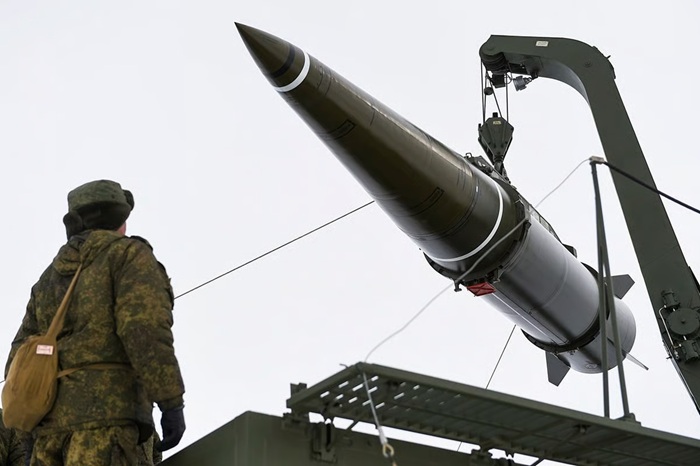
The standard Iskander-M (9K720, NATO: SS-26 Stone) is officially rated for a maximum range of 500 kilometers. 

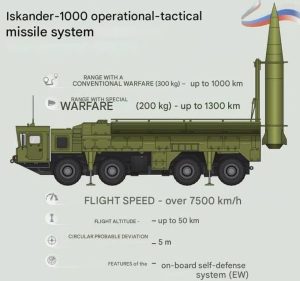
The newly confirmed strike exceeds that threshold by a wide margin, indicating that Russia has fielded an upgraded variant long discussed in military circles under the informal label “Iskander-1000.”

Russia Unveils Longer-Range Iskander Missile
Russia Unveils Longer-Range Iskander Missile

“A Different Flight Profile”

According to monitoring data cited by multiple sources, the missile followed a quasi-ballistic trajectory distinct from earlier Iskander-M launches. 

It reportedly maneuvered throughout its flight and executed a near-vertical terminal dive approaching 90 degrees. 

The extended range and altered profile significantly compress warning and interception timelines.

Air defense reaction windows are assessed to have fallen from the typical 15–20 minutes associated with longer-range cruise missile threats to as little as 2–7 minutes, depending on launch location. 

The missile is also reported to reach hypersonic speeds comparable to Mach 8–9, placing it closer in performance to Russia’s Kh-47M2 Kinzhal than to earlier Iskander variants.

From Rumor to Operational Capability

Speculation about an extended-range Iskander variant began circulating in Russian media as early as mid-2024, often linked to testing activity at the Kapustin Yar missile range. 

Those reports pointed to increased fuel volume, advanced propellants, and incremental guidance upgrades as the means of extending range beyond the limits imposed by the original design.

With confirmed operational use at approximately 800 km in late 2025, the system appears to have moved beyond the testing phase. 

While exact technical specifications remain undisclosed, the confirmed strike suggests that Russia has succeeded in fielding a longer-range tactical ballistic missile without formally reclassifying it as a strategic system.

Implications for Air Defense

The confirmed use of an extended-range Iskander materially alters the air defense environment. 

Targets deeper inside Ukraine can now be struck from launch sites farther from the front line, complicating detection, attribution, and interception. 

Even advanced systems such as Patriot have had limited success against standard Iskander-M missiles, and the shortened reaction time further strains interceptor coverage.

The missile’s maneuvering trajectory and steep terminal descent reduce engagement opportunities and challenge radar tracking, particularly when combined with saturation attacks or decoys. 

From an operational standpoint, the system blurs the line between tactical and theater-level strike capabilities.


Continue Reading
Click to comment

Leave a Reply

Your email address will not be published. Required fields are marked *

Europe

Ukraine Backs Multi-Tier Plan to Enforce Ceasefire

Published

on

Ukraine and its Western partners have agreed on a multi-tier enforcement plan under which repeated Russian violations of any future ceasefire would trigger escalating responses, including European intervention backed by US military support.

According to the Financial Times, Ukrainian, European and American officials have reached agreement on a multi-tiered enforcement mechanism designed to deter and respond to Russian violations of any future ceasefire agreement.

The proposal, discussed repeatedly in December and January, outlines a graduated response ranging from diplomatic warnings to direct military intervention backed by the United States.

Three Phases of Response

Officials familiar with the discussions told the Financial Times that any Russian breach of a ceasefire would trigger action within 24 hours, starting with diplomatic warnings and Ukrainian military steps to halt localized violations.

If hostilities persist, a second phase would involve forces from a “coalition of the willing”, including many EU states as well as the UK, Norway, Iceland and Türkiye.

Should the breach escalate into a broader attack, a third phase would be activated within 72 hours, involving a coordinated military response by western-backed forces with direct US military support.

Security Talks and Diplomatic Push

The plan was discussed by Ukrainian, European and American officials in Paris in December, with follow-up talks held in Kyiv on January 3 among national security advisers from coalition countries.

Officials said Ukrainian President Volodymyr Zelenskyy also raised the issue of US commitments during a meeting with Donald Trump at Mar-a-Lago in December.

Meanwhile, envoys from Kyiv, Moscow and Washington are scheduled to meet again this week in Abu Dhabi for renewed efforts to end the war.

European Troop Commitments

The Financial Times reported that France and the UK have pledged to deploy troops and weapons to Ukraine as part of security guarantees supported by the US, under a proposed 20-point peace framework.

A European-led deterrence force would provide reassurance on land, at sea and in the air, supported by US intelligence and logistics, according to leaders of Kyiv’s key allies.

The US has also offered advanced monitoring technologies along the 1,400-kilometre front line to help detect violations.

Lessons From Failed Ceasefires

Ukraine’s insistence on robust enforcement stems from past experience. Russia breached multiple ceasefires following its initial 2014 incursion into eastern Ukraine’s Donetsk and Luhansk regions.

The Minsk agreements of 2014 and 2015 failed in part because international monitors lacked enforcement authority or western security guarantees, ultimately paving the way for Russia’s full-scale invasion in 2022.

Security Guarantees Still Conditional

Zelensky said in January that security guarantees negotiated with the US, with European input, were “100 per cent ready”, pending confirmation of a signing date.

Trump has proposed what Zelenskyy described as “Nato-like” guarantees, similar to Article 5, reportedly lasting 15 years — though Kyiv is seeking to extend them to 50 years.

Ukraine has also proposed maintaining an 800,000-strong army, supported by western weapons and training, as part of the security package.

Continue Reading

Europe

“Trump Hasn’t Changed His Mind on Greenland”

Published

on

Greenland Premier Jens-Frederik Nielsen says Washington’s objective is still unchanged, raising stakes for Arctic sovereignty even as U.S.-Denmark-Greenland relations soften amid trilateral talks opened after Davos.

Premier Jens-Frederik Nielsen told parliament in Nuuk on Monday that U.S. President Donald Trump’s position on the Arctic territory and its population has not shifted, even after the U.S. president stepped back from explicit coercive language.

Nielsen’s assessment crystallizes the dispute as a sovereignty test inside a tightening great-power competition across the Arctic, where security, minerals, and sea routes increasingly intersect.

In his address, Nielsen framed the U.S. stance as unambiguous: “Greenland must be taken over and governed by the US.” He added, “Unfortunately, this remains valid and unchanged.”

Those remarks followed Trump’s earlier calls for U.S. control on national security grounds tied to Russia and China, and a period in which Washington threatened sanctions against European governments that opposed the move.

From Threats to Framework

The immediate temperature dropped after Trump met NATO Secretary General Mark Rutte at the World Economic Forum in Davos in 2025. Trump withdrew the sanctions threat and said a framework had been established for talks covering Greenland and the broader Arctic.

Trilateral discussions among the United States, Denmark, and Greenland began last week, marking the first formal channel since Trump’s public escalation.

Yet Greenland’s leadership has paired engagement with firm red lines. On Jan. 13, Nielsen set out Nuuk’s alignment choices in stark terms: “If we have to choose between the United States and Denmark here and now, we choose Denmark. We choose NATO. We choose the Kingdom of Denmark. We choose the EU.”

“We Choose Denmark”

Economic cooperation remains on the table, but only under Greenlandic rules. On Jan. 22, Nielsen said resource development must meet local law and culture: “If you want to exploit our resources, you have to respect our legislation and our very high environmental standards, because that is part of who we are and part of our culture.”

He added a conditional openness: “But we are ready to discuss anything on mutual respect.”

Denmark has reinforced that position publicly. On Jan. 1, Prime Minister Mette Frederiksen described a year of strain from allied pressure, where they had to endure a great deal of threats and condescending rhetoric, even from their “closest allies of a lifetime.”

She also rejected the premise of acquisition in stark terms.

Talk of taking over another country and another people, as if they were something that could be bought and owned. That has no place anywhere.

Danish Prime Minister Mette Frederiksen

Arctic Leverage, Alliance Limits

Together, the statements map a coordinated front across Nuuk and Copenhagen while keeping channels open in Washington. The dispute now sits inside a three-way diplomatic process, with Greenland asserting autonomy, Denmark anchoring sovereignty, and the United States pressing strategic interests.

For allies following Arctic dynamics – including Türkiye, which tracks NATO cohesion and northern security shifts – the episode illustrates how smaller territories become focal points when climate change and geopolitics converge.

The chronology matters. Trump’s renewed push intensified in 2025, with public threats preceding Davos, a framework announced after that meeting, and formal talks opening last week.

Since the start of the whole Arctic saga, Greenland and Denmark have used successive statements to harden their negotiating posture: alignment with NATO and the EU, conditional openness to investment, and a categorical rejection of ownership logic.

The result is a controlled de-escalation in tone without movement on substance – a reminder that Arctic diplomacy is now inseparable from alliance politics.

Continue Reading

Europe

Former Duchess of York Sarah Ferguson Closes Charity as Epstein Emails Surface

Published

on

Sarah Ferguson’s charity announced closure on Monday after the U.S. Justice Department released over 3 million Epstein-related pages, including emails linking Ferguson to Jeffrey Epstein. The move underscores widening fallout as political and royal figures face renewed scrutiny.

Sarah Ferguson’s charity, Sarah’s Trust, said it will close “for the foreseeable future” days after the U.S. Department of Justice (DoJ) released a vast new tranche of Jeffrey Epstein records that included emails appearing to show contact between Ferguson and the late financier after his conviction. A spokesman for the foundation said the decision followed discussions spanning “some months,” but the timing places the closure squarely within the expanding institutional impact of the Epstein disclosures.

Document Dump Drives Fallout

Deputy Attorney General Todd Blanche said the DoJ was producing more than 3 million pages, including more than 2,000 videos and 180,000 images “related to Epstein,” reviving the case and intensifying pressure on political, financial, and social elites as the scope of the disclosures widens.

Among those materials were email exchanges that appear to show Ferguson communicating with Epstein while he was imprisoned for soliciting sex from a minor.

Even though solely being named in the files is not a direct indication of wrongdoing, Sarah’s Trust, through its spokesman, confirmed that the charity was closing. The spokesman said “our chair Sarah Ferguson and the board of trustees have agreed that with regret the charity will shortly close for the foreseeable future,” adding that the decision had been “in train for some months.”

Emails, Flights, and Meetings

The released documents outline a detailed chronology of post-conviction contact. Epstein was freed on July 22, 2009, after serving 13 months of an 18-month sentence. An email dated June 14, 2009 from a sender identified as “Sarah” asked Epstein for business guidance. On June 26, 2009, the same sender wrote: “I am alive… yes I did go to the first lady and she loved the Mothers Army. I am going to call you later Love you.”

According to BBC News, an email thread showed flight arrangements for Sarah Ferguson and two assistants from London to Miami, then to New York, before returning to London.

On July 24, 2009, Epstein’s assistant Lesley Groff confirmed British Airways tickets totaling $14,080.10, which Epstein approved.

Emails also point to a lunch meeting at Epstein’s Palm Beach home on July 27, 2009, at 358 El Brillo, with plans including Ferguson and her daughters, with a reply from “Sarah” saying, “Cannot wait to see you.”

The correspondence suggests at least three additional meetings in 2009, during a period when Epstein was under house arrest that lasted until summer 2010.

Other emails show Ferguson praising Epstein as the “brother I have always wished for,” congratulating him on the arrival of a “baby boy,” and seeking advice for Mothers Army, a company listed at Companies House under Sarah Margaret Ferguson with a registered address at Royal Lodge, Windsor Great Park.

Reputational Cascade Across Charities

The renewed attention follows earlier consequences. Previous disclosures led to Ferguson being removed last year as patron or ambassador from multiple organizations, including Julia’s House, the Teenage Cancer Trust, Natasha Allergy Research Foundation, Children’s Literacy Charity, National Foundation for Retired Service Animals, Prevent Breast Cancer, and the British Heart Foundation.

The latest DoJ files also included images of Ferguson’s former husband, Andrew Mountbatten-Windsor, kneeling over a woman on the floor. Mountbatten-Windsor has “always consistently and strenuously denied any wrongdoing.”

Political Pressure Widens

The Epstein document release is now extending beyond royal-linked institutions. Today, Bill Clinton and Hillary Clinton agreed to testify before Congress as part of a House Oversight Committee investigation into Epstein, a decision that came days before a scheduled vote to hold them in contempt of Congress after months of seeking their testimony.

The development signals how the DoJ’s multi-million-page disclosure is intensifying scrutiny across political, philanthropic, and public life simultaneously.

Continue Reading

Trending