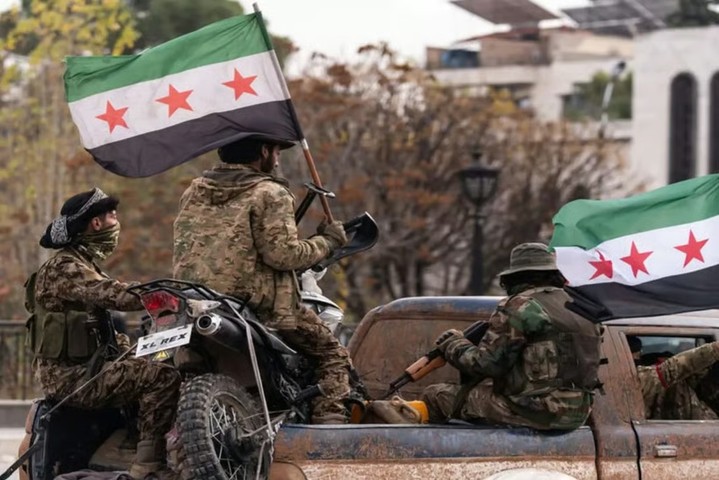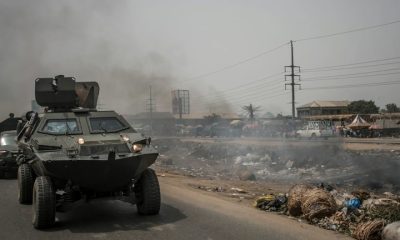
The Syrian government and the SDF have reached an understanding on Hasakah’s future, giving the group four days to submit a detailed integration plan. As a ceasefire takes effect, the US has urged the YPG to integrate into the Syrian state, signaling a shift in policy.
In a written statement released last night, the Syrian Presidency announced that the Syrian government and the SDF terrorist group had reached a joint understanding on a series of issues related to the future of Hasakah province. The statement said the SDF was granted four days to prepare a detailed plan regarding the integration of the areas under its control into the Syrian state and to complete consultations between the parties.
It was also announced that a four-day ceasefire entered into force at 20:00 last night. Should an agreement be finalized, Syrian forces will not enter the city centers of Hasakah and Qamishli but will instead be deployed around their perimeters. The timetable and technical details for the peaceful integration of Hasakah province, including the city of Qamishli, will be addressed at a later stage.
Clear Message from the US to the YPG: “Time for Integration”
US Ambassador to Ankara and Special Envoy for Syria Tom Barrack signaled a new phase in Washington’s approach toward the SDF terrorist group in a statement posted on social media. Barrack issued a direct call to the YPG, the Syrian branch of the PKK terrorist organization, saying: “Integrate into the Syrian state.”
Barrack stated that the SDF’s role as the primary on-the-ground force against ISIS terrorist group in Syria has largely come to an end, adding that “the era of the YPG being the number one partner is over.” Emphasizing that Syria now has a recognized central government cooperating with the United States on counterterrorism, Barrack described the current process as a “historic opportunity” for Kurds.
Details of the Integration Agreement
The US diplomat also referred to the details of the integration agreement signed on January 18. According to the agreement, SDF militans are expected to join the Syrian national army on an individual basis, while strategic assets such as oil fields, dams, and border crossings are to be transferred to the Damascus administration.
Barrack underlined that the United States does not support the continuation of a separate SDF structure, but instead seeks to facilitate a peaceful transition in Syria. His remarks were widely interpreted as signaling a fundamental shift in Washington’s political and military posture toward the SDF.
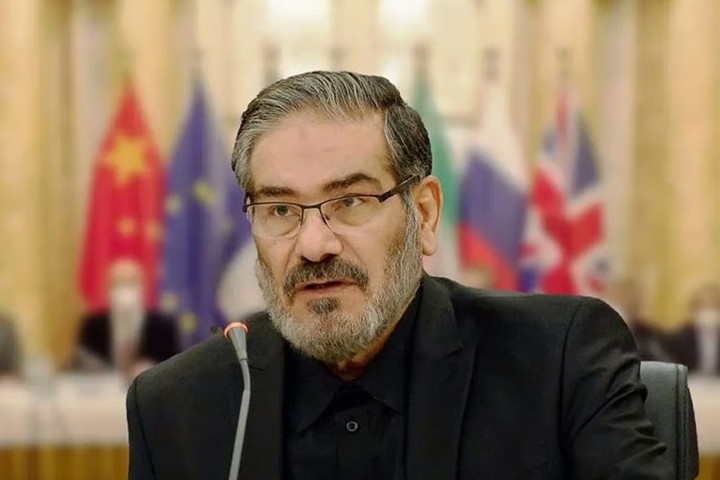
Iran is effectively living under war conditions and is prepared for all scenarios, a senior advisor to Supreme Leader Ayatollah Ali Khamenei said, while signalling that Tehran could reduce uranium enrichment from 60% to 20% if it receives concessions in return.
Ali Shamkhani, a senior advisor to Iran’s Supreme Leader Ayatollah Ali Khamenei, said Iran’s nuclear programme remains entirely peaceful and rejected claims that uranium enriched to 60% is intended for military use.
Speaking to Lebanon-based Al-Mayadeen television, Shamkhani said Iran could lower its uranium enrichment level from 60% to 20%, a move long sought by Western powers, but stressed that such a step would require a “price”.
Enrichment at 60% can be reduced to 20%, but it must come at a price. We do not know exactly how much enriched uranium remains, because some of it is buried under rubble and has not been recovered due to the risks involved.
Ali Shamkhani, Senior Advisor of Iran’s Supreme Leader
He said Iran has no intention of transferring its enriched uranium abroad, adding that this option is now “completely off the table”.
“We Are Living in the Shadow of War”
Shamkhani described Iran’s current situation as one shaped by constant pressure and the threat of conflict, saying the country is already living under wartime conditions.
He said Iran’s enemies have imposed unjust conditions, unjust threats and an unjust war environment, while preparing for confrontation with all their strength. According to Shamkhani, Tehran is therefore ready for any possible scenario.
Europe Sidelined, US Seen as Sole Counterpart
Shamkhani said Europe has been effectively sidelined from the nuclear process since former US president Donald Trump withdrew from the 2015 nuclear deal in 2018.
He said European countries were unable to play any meaningful role either after the withdrawal or during negotiations held ahead of last June’s conflict. According to Shamkhani, Trump did not allow European parties to intervene in the process.
As a result, Shamkhani said the nuclear issue can only be discussed directly with the United States and strictly within the framework of nuclear negotiations, adding that reaching an agreement with Washington remains possible.
Uncertainty Over Uranium Stockpiles
Shamkhani also said Iran does not know exactly how much enriched uranium it currently holds. He said part of the stockpile is buried under rubble and has not been recovered due to the risks involved.
No steps have been taken to extract those materials so far, he added, citing safety concerns.
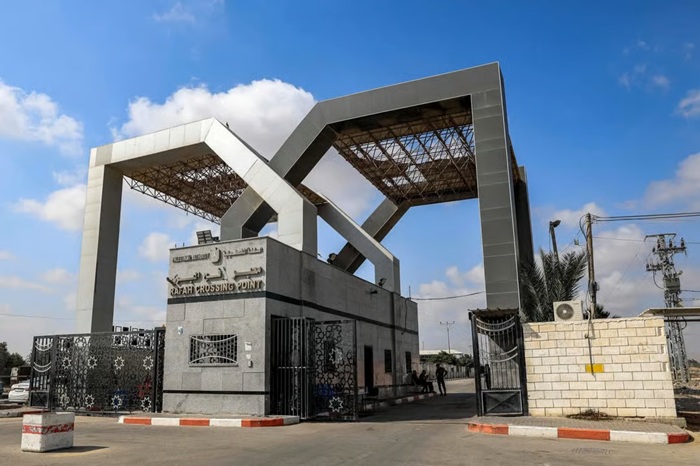
Israel said it will reopen Gaza’s Rafah crossing on Sunday for limited civilian movement under Israeli inspection, EU supervision, and Egyptian coordination.
Israeli authorities say the crossing, closed for nearly two years, will reopen on Sunday for limited civilian transit only, tightly controlled by Israeli security procedures.
The reopening aligns with provisions outlined in the second phase of the ceasefire agreement, though no firm timetable for broader implementation has been announced.
The Coordinator of Government Activities in the Territories (COGAT), an Israeli defense ministry body, said on Friday that “exit from and entry into the Gaza Strip via the Rafah Crossing will be permitted in coordination with Egypt, following prior security clearance of individuals by Israel, and under the supervision of the European Union mission.”
COGAT added that the mechanism would mirror arrangements used in January 2025, including an additional screening and identification process at a corridor under Israeli military control.
“Limited Manner, Full Inspection”
Israeli Prime Minister Benjamin Netanyahu underscored the security-first approach on Jan 28, stating, “We agreed to open the Rafah crossing in a limited manner, and only with our inspection.”
He added that it will be for people only, in limited numbers, and “everyone who exits or enters will undergo our inspection – a full inspection.”
Israeli officials say the initial phase will allow dozens of Palestinians per day in each direction, prioritizing medical evacuees and civilians displaced during the war.
An Israeli official, speaking on condition of anonymity, told The Associated Press that movement would begin with cases approved in advance, including wounded civilians and those requiring specialized medical care unavailable in Gaza. According to Gaza’s health ministry, roughly 20,000 sick and wounded Palestinians currently require treatment outside the enclave, where hospitals and surgical capacity were severely degraded during the conflict.
Humanitarian Pressure at the Crossing
Rafah has historically been the primary gateway between Gaza and Egypt and a critical conduit for humanitarian access. Gaza is home to approximately 2 million people, many displaced multiple times and facing shortages of food, shelter, and medicine. Thousands inside Gaza are seeking to leave, while tens of thousands who fled earlier phases of fighting are seeking to return. Under the announced plan, only Palestinians who left Gaza during the war will be permitted to re-enter, and only after Israeli security clearance coordinated with Egypt.
Hamas responded by calling for full implementation of the ceasefire terms, urging Israel to open the crossing “in both directions without restrictions.” Israeli officials, however, maintain that control of Rafah remains a security imperative, particularly following the return of the remains of the last Israeli captive earlier this week, which concluded a core component of the ceasefire’s first phase.
External Oversight, Narrow Scope
The reopening will take place under the supervision of the European Union Border Assistance Mission, with Egypt coordinating on its side of the crossing. While the arrangement restores a degree of civilian movement after nearly 24 months of closure, Israeli statements make clear that Rafah will not function as an unrestricted border. The scope is limited to people, not goods, and all transit remains subject to Israeli approval.
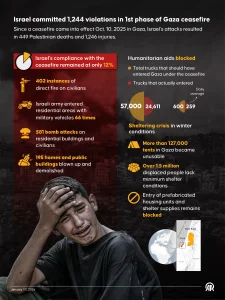
The record on the ground appears to be far worse. An infographic by Anadolu Agency reporting shows Israel committed 1,244 ceasefire violations in Gaza after the truce took effect on October 10, 2025, resulting in 449 Palestinian deaths and 1,246 injuries. The report cites major restrictions on aid deliveries, and a shelter crisis affecting more than 1.5 million displaced people during winter conditions, claiming that Israel’s compliance only amounted to 12% of the provisions of the ceasefire deal.
U.S. officials have reportedly warned a regional ally that a potential military strike against Iran could begin as early as Sunday, according to claims circulating in the American press amid rising regional tensions.
According to Drop Site News, American officials have alerted a regional ally that a potential strike against Iran could begin on Sunday. The alleged operation is said to extend beyond nuclear and missile infrastructure, with claims that Iran’s leadership itself could also be among the targets.
Trump’s Remarks Fuel Speculation
The reports follow recent comments by U.S. President Donald Trump, who stated that he had given Iran a “deadline for a deal.” His remarks have been widely interpreted in Washington as a signal that the military option remains under active consideration if diplomacy fails.
Regime Change Claims
Drop Site News reported that Trump could approve a strike on Iran as early as this weekend. The outlet claimed that the proposed operation would aim not only to degrade Iran’s military capabilities but could also seek to trigger regime change.
CENTCOM warning in the Strait of Hormuz
Meanwhile, U.S. Central Command (CENTCOM) issued a warning to Iran ahead of planned military exercises in the Strait of Hormuz. CENTCOM cautioned Iranian forces against approaching U.S. troops and stressed that maneuvers posing a threat to American personnel would not be tolerated.
Iran signals possible retaliation
In response, Ali Shamkhani, an adviser to Iran’s Supreme Leader Ayatollah Ali Khamenei, warned that any attack on Iran could prompt strikes deep inside Israel, raising fears of a broader regional escalation.
U.S. naval deployment highlighted
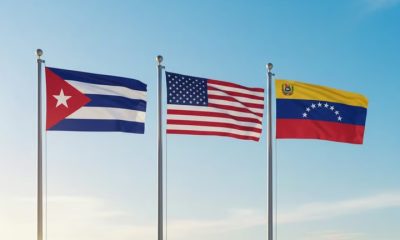
Trump also underscored the scale of U.S. military deployments, saying the American naval force moving toward Iran was larger than the fleet sent toward Venezuela. He reiterated his warning that there would be consequences if no agreement is reached with Tehran.