Egypt and Saudi Arabia pressured Libya’s Khalifa Haftar to halt military support to UAE-linked RSF in Sudan, citing arms, fuel, and mercenary flows via eastern Libya amid international condemnation of massacres perpetrated by RSF paramilitaries.
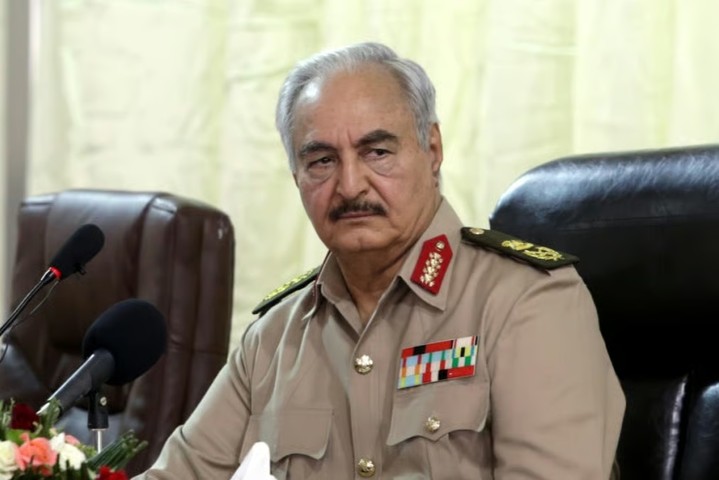
Egypt and Saudi Arabia have escalated pressure on eastern Libyan commander Khalifa Haftar, treating his alleged facilitation of Emirati support to Sudan’s Rapid Support Forces (RSF) as a strategic liability rather than a tolerable ambiguity.
According to a Middle East Eye exclusive story, Cairo warned that continued assistance could trigger a fundamental reassessment of its long-standing relationship with Haftar, reframing him from security partner to regional risk.
The issue is not ideological alignment but logistics: arms, fuel, drones, and fighters moving across Libya into Sudan since the outbreak of war in April 2023. Egyptian officials now argue that these supply chains have materially altered the battlefield, enabling RSF advances and deepening instability along the Egypt-Libya-Sudan border triangle.
“Summoned, Not Invited”
Earlier this month, Saddam Haftar, Khalifa Haftar’s son and deputy commander-in-chief of the Libyan Arab Armed Forces (LAAF), was called to Cairo for meetings with Egyptian Defense Minister Abdel Meguid Saker and senior intelligence officials.
A senior Egyptian army source told Middle East Eye that Saddam Haftar was “literally summoned to Egypt, not invited for a courtesy visit,” after Cairo confirmed Emirati weapons transfers to the RSF with LAAF assistance. The source said officials presented evidence of fuel deliveries from Libya’s Sarir refinery to RSF leader Mohamed Hamdan Dagalo, alongside shipments of weapons, portable air defense systems, and drones from the UAE. Egyptian intelligence, the source added, holds aerial imagery tracing weapons movements from Abu Dhabi to eastern Libya and onward into Darfur.
The Sudan conflict has produced stark benchmarks. Since April 2023, the RSF has expanded its control across Darfur, including the fall of el-Fasher after a siege lasting more than 550 days. Thousands are believed to have been killed there, with satellite imagery indicating widespread killings in El Fasher following its capture by Sudan’s Rapid Support Forces (RSF), showing mass graves, large concentrations of bodies, and apparent cremation sites. British MPs were told at least 60,000 people are believed to have been killed, with up to 150,000 residents missing since the city fell on 26 October 2025.
Human rights experts say the evidence points to one of the gravest crimes of the Sudan war, which has already been defined by large-scale atrocities and ethnic cleansing.
Accordingly, Egyptian officials assess that RSF logistics routes established in June, particularly through Libya, directly enabled such outcome. “Without such support, the RSF would not have achieved its recent advances,” the Egyptian source said.
Escalation Control at the Border
Warnings to Haftar were reinforced by direct military action. A second Egyptian military source said Cairo conducted an air strike on a convoy crossing from Libya toward RSF-held territory near the al-Uwaynat border triangle, southwest of Egypt and southeast of Libya’s Kufra region.
The convoy included dozens of vehicles carrying fuel, weapons, and military equipment. “Most of the vehicles were destroyed and fuel trucks caught fire,” the source said.
Egyptian armed forces have since maintained continuous air patrols, with instructions that “any military movement from Libya towards Sudan to support Hemedti’s militia will be targeted.”
Satellite imagery strengthens Cairo’s claims of Haftar’s supply chains to RSF. AfriMEOSINT reported that imagery from August to September showed heavy UAE-linked IL-76 cargo aircraft activity at Kufra Airport, consistent with arms deliveries and the movement of foreign fighters.
Egyptian intelligence also monitored, via audio and visual surveillance, the arrival of mercenaries from Colombia and Venezuela into Libya before their transfer to Sudan, according to the same army source.
Regional Realignment Pressures
Cairo and Riyadh have paired coercion with incentives. According to the Egyptian army official, both offered Saddam Haftar alternative financial and military support to replace Emirati backing. The meetings were followed by a Saudi arms deal with Pakistan worth $4bn, with weapons expected to be distributed between Haftar’s forces and Sudan’s army under Abdel Fattah al-Burhan. Egyptian officials also warned Haftar of alleged Emirati contingency plans to fragment Libya once the RSF consolidates control over Darfur and Kordofan, including separating Jufra and Sirte.
The pressure campaign unfolds amid an unusually public rift between Saudi Arabia and the UAE. Recent developments underscore growing Saudi pressure against Emirati activism across the region.
In Yemen, Saudi-backed government forces, supported by Riyadh’s air power, swiftly rolled back gains made by the UAE-backed Southern Transitional Council earlier this month, forcing its leader Aidarous al-Zubaidi to flee after just five days.
The episode was accompanied by rare public exchanges of criticism between Riyadh and Abu Dhabi, signalling a more assertive Saudi stance. Egypt has aligned with this push, with Middle East Eye reporting that Cairo shared intelligence with Saudi Arabia on Emirati activities. A Cairo-based analyst told MEE that the UAE’s backing of the RSF fits a wider strategy to shape outcomes in Sudan and Libya, but one that increasingly collides with Saudi interests, as Riyadh views the RSF’s rise as destabilising and a direct challenge to Saudi-backed forces in Yemen.
Accordingly, Saudi writer Dr. Ahmed bin Othman Al-Tuwaijri argued in Al-Jazirah that Abu Dhabi’s regional policy works “to give Israel a foothold in the Horn of Africa and control Bab al-Mandab.”
The article further accused UAE of issuing explicit directives “to prepare military bases to serve Israeli operations in Gaza”, alleging Emirati interference from Tunisia to Somalia and efforts to secure Bab al-Mandab for Israel.
Russia has echoed similar critiques at the UN. On Dec. 24, envoy Vassily Nebenzya said Washington and its partners were “deliberately foment[ing] tensions” under the pretext of counterterrorism, using Sudan and Libya as pressure points.







 Europe4 weeks ago
 America4 weeks ago
 America4 weeks ago
 Europe4 weeks ago
 Africa4 weeks ago
 Middle East4 weeks ago
 America4 weeks ago
 America4 weeks ago