
Popular
Armed Attack at Bondi Beach in Australia: 15 Dead, Dozens Injured

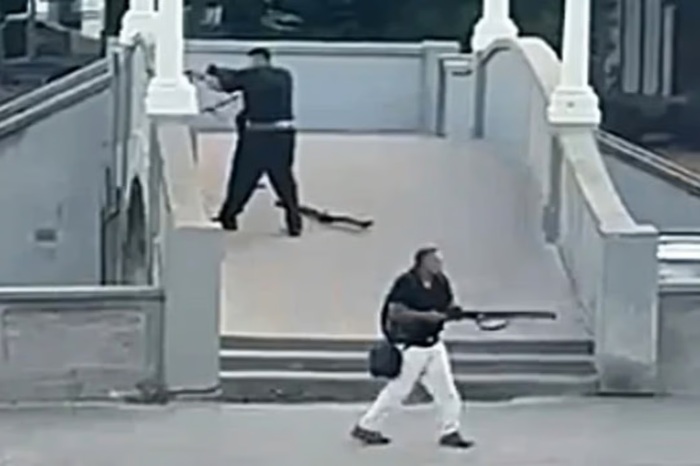
An armed attack at a beach in Sydney, in Australia’s New South Wales (NSW) state, left 15 people dead and 38 others injured, including two police officers and one child.
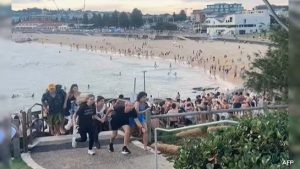
The armed attack occurred at around 6.47 p.m. local time at Bondi Beach in Sydney, in the state of New South Wales (NSW). In its initial statement shared on social media, NSW Police announced that an active armed attack was underway at the beach and urged the public to stay away from the area. Large numbers of police officers, paramedics, and emergency response teams were dispatched to the scene.
Authorities said long-barreled firearms were used in the attack. Police secured the area by land, sea, and air, while boats and helicopters were deployed. Bomb disposal units were brought in after suspicious objects were detected during searches.
Death Toll and Number of Injured Confirmed
NSW Health Minister Ryan Park said one of the victims was a child and confirmed that 15 people had lost their lives. He stated that 38 people were injured, including two police officers and one child, and that four children were transferred to Sydney Children’s Hospital. Some of the injured were reported to be in serious condition.
NSW Premier Chris Minns later said the ages of those killed ranged from 10 to 87 and that the number of injured had risen to 42, with treatment ongoing in hospitals.
Terror Investigation and Hanukkah Focus
Authorities emphasized that the attack was aimed at the Jewish community and is being treated as a terrorist act. The fact that the shooting took place during Hanukkah, a major holiday in the Jewish calendar, was considered a key factor in the security assessment. NSW Police announced that security measures had been increased at synagogues and Jewish community sites throughout the holiday period.
NSW Police Commissioner Mal Lanyon said the investigation was complex and multi-layered, noting that such attacks are often intended to inflame social tensions during sensitive periods.

Attackers Identified as Father and Son
Following identification efforts, authorities confirmed that the attackers were a 50-year-old father and his 24-year-old son. The father was killed at the scene, while the son remains hospitalized in critical condition. Officials said the father was a licensed gun owner and that six legally owned firearms belonging to him were recovered at the scene.
After the attack, police discovered several suspicious objects believed to be homemade explosive devices in a parked vehicle near Bondi Beach. Bomb disposal teams safely removed the items and handed the scene over to forensic investigators.
After the attack, police found several suspicious objects believed to be homemade explosive devices in a parked vehicle near Bondi Beach. Bomb disposal units safely removed the objects from the scene and handed the area over to forensic specialists.
Authorities said that during the attack targeting Hanukkah celebrations, one of the assailants was neutralized by 43-year-old fruit vendor Ahmed el-Ahmed. Footage shows Ahmed, who lives in the Sutherland Shire area, approaching the attacker from behind, seizing his rifle and forcing him to retreat.
Ahmed then leaned the weapon against a tree and raised his hands to demonstrate that he posed no threat to police. During the intervention, he was shot twice by a second attacker—once in the arm and once in the hand. Ahmed underwent surgery on Sunday night, and his condition was reported to be improving.
Israeli Prime Minister Benjamin Netanyahu praised Ahmed el-Ahmed’s actions during a government meeting in Dimona on Sunday. “We saw the act of a brave man — and it turned out he was a brave Muslim man. I salute him. He prevented the killing of innocent Jews,” Netanyahu said.
In the same remarks, Netanyahu also criticized Australian Prime Minister Anthony Albanese, arguing that Australia’s current policies are “fueling antisemitism.” His comments further intensified the diplomatic and political tensions following the attack.
Netanyahu’s Sharp Criticism of Albanese
Following the attack, one of the most prominent critics of Australian Prime Minister Anthony Albanese was Israeli Prime Minister Benjamin Netanyahu. The right-wing Israeli leader accused Albanese’s center-left government of failing to adequately protect the Jewish community in Australia and linked the attack to Canberra’s stance on recognizing a Palestinian state.
Netanyahu said, “Your call for a Palestinian state is pouring fuel on the anti-Jewish fire,” arguing that this approach encourages those who threaten Australian Jews and fuels antisemitic hatred on the country’s streets. He later reiterated these views in social media posts.
Albanese, who has faced growing criticism after the deadly shooting at Sydney’s Bondi Beach, pledged to review Australia’s gun laws and to increase support and security measures for Jewish Australians.
Muslim Cemetery Desecrated
In a development that deepened fears of escalating communal tensions, a Muslim cemetery in Sydney’s south-west was allegedly desecrated with butchered pig heads and other animal remains. New South Wales Police said officers were alerted shortly after 6 a.m. to reports of animal carcasses placed at the entrance of the cemetery on Richardson Road in Narellan.
Police from the Camden Police Area Command responded to the scene and discovered multiple severed pig heads, an act widely viewed as deliberately provocative and offensive. Authorities said an investigation was launched immediately, with the remains swiftly removed and disposed of under official procedures.
The incident has raised alarm among community leaders, who warned that such acts risk inflaming religious and ethnic divisions in the aftermath of the Bondi Beach attack. The cemetery, located on land purchased in 2008 by the Lebanese Muslim Association from St Thomas’ Anglican Church to address a shortage of Muslim burial sites, has now become the focus of a separate hate crime investigation.
Police said inquiries are ongoing and urged the public to avoid speculation while investigators work to establish responsibility.

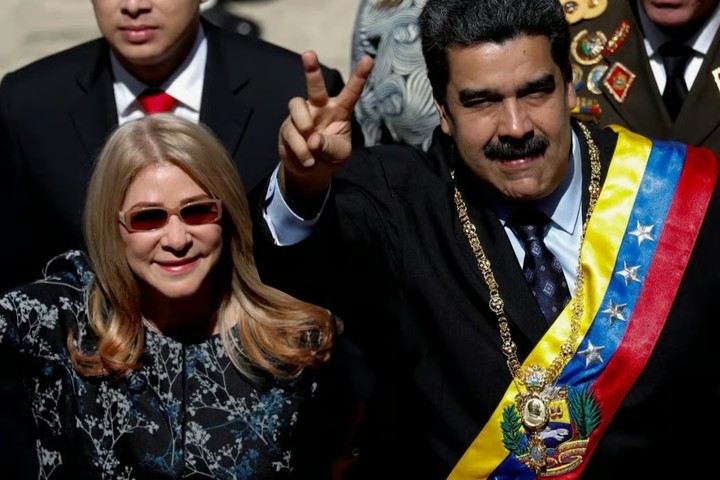
As Yunus Emre Erdölen underlines, Trump’s concern is neither democracy nor drugs; as he himself openly states, it is Venezuelan oil and U.S. interests.What once happened behind closed doors in Trump’s new world is now unfolding right before our eyes. The rudeness of hard power stands naked in all its rawness and brutality. For this reason, seriously sitting down to debate whether “Maduro was good or bad” or whether “the attack was legal or illegal” has little importance in this new world.
Exactly 35 years ago, on January 3, 1990, American soldiers blasted rock songs through large speakers in front of the Vatican Embassy in Panama. The Clash’s “I Fought the Law,” U2’s “All I Want Is You,” and Bruce Cockburn’s “If I Had a Rocket Launcher” were just a few of the “symbolic” songs on the American soldiers’ playlist.
Of course, the American soldiers were not carrying out a cultural initiative to promote 1990s hit songs in a Latin American country hundreds of kilometers away from their homeland. When Panama’s dictator Manuel Noriega—once supported by the CIA and the United States—began acting against U.S. interests and using money obtained from drug trafficking against America, U.S. President George H. W. Bush pressed the button and decided to remove Noriega. The operation that began in December 1989 involved 27,000 American troops; Panama was invaded, and Noriega, who had no real support among the people, could not resist and sought refuge in the Vatican Embassy.
To exert psychological pressure on Noriega, an opera-loving dictator, American soldiers surrounded the embassy building and blasted rock music at full volume day and night. However, this psychological torture lasted only three days. The Vatican told the United States that embassy staff were also disturbed and requested the music be stopped, and the Americans put the speakers back into their trunks.
Despite the end of the American rock music torture, Noriega’s resistance was broken in 10 days. Fearing that he would be lynched by his own people, he surrendered to American forces and was taken to the United States by Delta Force units to stand trial.
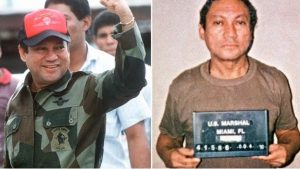
Noriega was sentenced to 40 years for drug trafficking and money laundering, released in 2007 for good behavior, then extradited to France where he was convicted and imprisoned, and later returned to Panama to serve his sentence there. He died at the age of 83 in the hospital where he was receiving treatment.
By sheer coincidence, exactly 35 years later, again on a January 3, American soldiers once more abducted a Latin American leader from his country with Delta Force units and brought him to the United States to stand trial.
But this time not by blasting rock music in front of an embassy—rather by storming a sitting president’s bedroom and abducting him and his wife in their pajamas, forcing them onto a helicopter.
Venezuela’s Curse, Law’s Lament
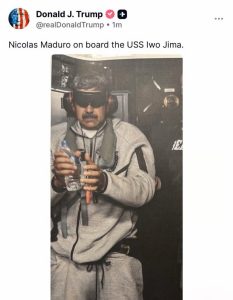
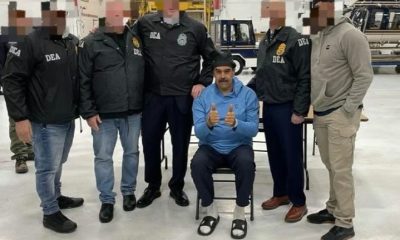
In the Venezuela operation—originally planned for Christmas but delayed due to attacks in Nigeria—the United States first bombed military targets and symbolic locations such as Chávez’s tomb. Then, using intelligence sources close to Maduro, a special Delta Force team raided the private compound where he was staying. American soldiers stormed Maduro and his wife’s bedroom and woke them from their sleep. As the couple ran toward their shelter, they were prevented from closing the door and were taken in their pajamas onto a helicopter, then transferred to a military ship waiting in open waters.
The “official” justification for the operation—which Trump himself said he watched “like watching television”—was drug trafficking and Maduro’s alleged anti-democratic rule. But Trump himself does not even emphasize these official reasons. Trump openly states that the United States will distribute Venezuelan oil and profit from it, even stressing that it will be managed in a way that benefits everyone by sharing it with countries like China.
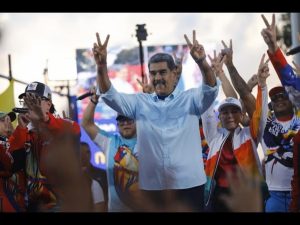
Trump’s decision to abduct a country’s leader from his bed without involving Congress violates both international law and American law. And yes, Maduro is an autocrat who condemned his country to rigged elections, high inflation, corruption, and poverty.
After Chávez’s death in 2013, Maduro took office and, when he lost the 2015 parliamentary elections to the opposition, steered decisively toward autocracy. First, in order to block the opposition’s constitutional majority, the Supreme Court annulled the mandates of three MPs, depriving the opposition of its two-thirds majority. Then, again through the court, parliament’s powers were stripped on the grounds of alleged electoral fraud and transferred to the judiciary, with parliamentary immunity lifted to prosecute lawmakers. Although parliament’s powers were later nominally restored amid backlash, Maduro’s government deemed the legislature illegitimate and ignored its will.
Maduro then called for a constituent assembly to draft a new constitution and held a referendum boycotted by the opposition. With only 41% turnout, Maduro supporters won all seats. The Constituent Assembly’s first act was to abolish the powers of the legitimately elected opposition parliament and redesign the political balance under Maduro’s command.
The opposition, which refused to recognize Maduro’s disputed 2018 victory, took to the streets, organized mass protests with millions participating, declared parliamentary speaker Juan Guaidó the legitimate president, and sought to delegitimize Maduro internationally. Rather than legitimizing a rigged system by narrowly losing, the opposition chose to reject it outright.
By clinging to power against his own people, Maduro imposed a permanent instability on his country, triggered a humanitarian crisis that forced 7 million people to flee over the past decade, and presided over a catastrophic economic collapse. Even left-wing governments in Colombia, Chile, and Brazil distanced themselves from Maduro. Still, the opposition persisted and organized a massive primary in 2023 with 2.5 million voters. Opposition leader María Corina Machado—who won 93% of the vote—later received the Nobel Peace Prize.
Despite mediation efforts by countries like Norway and agreements that politics should not be shaped through bans, Venezuela’s judiciary once again barred Machado from running and later excluded her substitute candidate from the ballot due to “technical issues.” Machado then arranged for the last-minute candidacy of little-known former diplomat Edmundo González, whom the Maduro government assumed could not win.
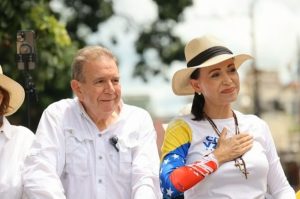
Under constant threat of arrest, Machado campaigned alongside González and mobilized voters despite political bans. Claiming victory based on signed tally sheets, the opposition was met with repression as the Maduro regime declared itself the winner with 51% and accused the opposition of disinformation. Numerous international bodies, including left-wing Latin American governments, questioned the election’s legitimacy. As repression intensified, the label “dictator” became openly used.
González, declared the legitimate president by Maduro-opposing countries, sought refuge in the Spanish consulate after publishing the tally sheets and fled to Madrid on a private military plane.
Two years later, it was Maduro who was forced to leave his country by helicopter—abducted from his bedroom on Trump’s orders. The Maduro regime was unplugged.
But none of this really matters. Because in Trump’s world, “who is right, who is wrong; what is democratic or not; what is legal or not” is irrelevant.
The Weak Are Crushed
Debates over whether Maduro is a “brave anti-imperialist” or a “brutal dictator” belong to the old world. In Trump’s new world, raw power reigns. States always suspended principles through hard power, but they used to at least cloak it in justification. Trump’s America no longer needs even that.
This is not about drugs—Trump just last week pardoned a former Honduran leader convicted of drug trafficking, calling the trial unfair.
This is not about democracy—Trump openly supports and praises autocrats worldwide and draws inspiration from them for his own country.
As Trump has made abundantly clear, this is about pure economic and pragmatic interests: oil and U.S. spheres of influence. What once happened behind closed doors is now done in plain sight. The message to the world is simple: only power matters. Maduro and his regime became the first to be eliminated in this new order because of their inability to even protect their leader’s bedroom.
There is little point in engaging in neat “neither Maduro nor the U.S.” debates or theoretical discussions in a world governed by brute force.
Like it or not, this is the new world order. The gates of hell are open; everything is permissible. When Trump feels like it, he can have a head of state abducted from his bed in pajamas.
This time not with rock music, but with a massive televised spectacle designed to distract from the Epstein files and win over Hispanic American voters fleeing left-wing autocrats ahead of the 2026 midterms.
Trump has launched the 2026 season of his new reality show, with himself as the star and the world as a powerless audience.
Maduro was the first contestant to be voted off the island.
This year’s theme: Stable chaos.
We’d better get used to it. Unfortunately.


-
 Europe4 weeks ago
Athens FIR Hit by “Unprecedented” Radio Interference
-
 America4 weeks ago
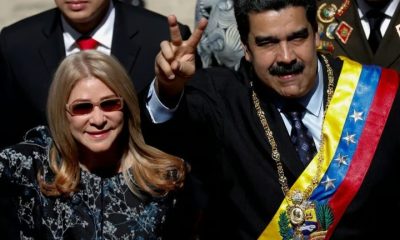
The First Casualty of Trump’s New World: Welcome to Stable Chaos, Goodbye Maduro
-
 America4 weeks ago
Cuba Reports 32 Killed in US Venezuela Raid
-
 Europe4 weeks ago
Denmark Tells Trump to Halt Greenland Threats
-
 Africa4 weeks ago
Gunmen Kill Dozens in Nigeria Market Attack
-
 America4 weeks ago
Venezuela Interim Leader Offers US Cooperation
-
 Middle East4 weeks ago
Israeli F-35 Technology Will Not Be Shared With Türkiye
-
 America4 weeks ago
NYT: Trump Offered Maduro Exile in Türkiye